
FIELD REPORT: FOUR DAYS SCOUTING THE BLACK ROCK DESERT


There's a huge difference between heading out on a well-mapped trail and embarking on a true backcountry scouting mission. When we scout out remote terrain, we are testing vehicle limits, verifying route conditions, mapping out safe corridors for future groups, and solving the unexpected problems that the wilderness loves to throw at you.
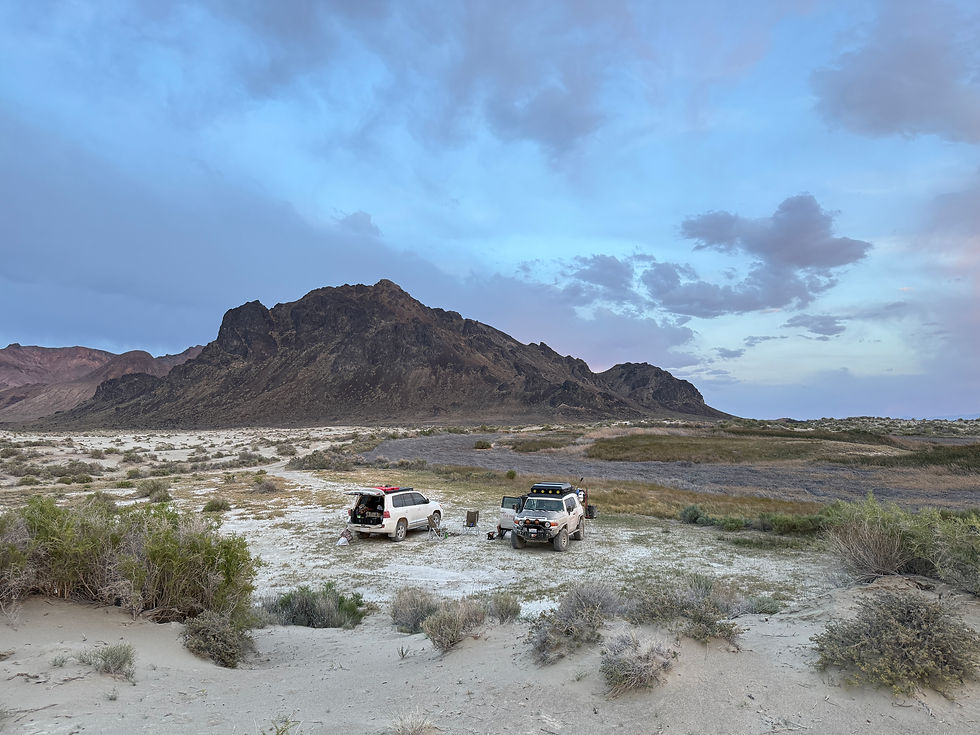
We recently wrapped up a spectacular (and grueling) four-day overland expedition through the vast and unpredictable Black Rock Desert, tracking the terrain from West to East. Over the course of those four days, we encountered breathtaking canyons, hidden geothermal hot springs, stunning fields of natural obsidian, and ancient frontier lore. We also encountered a lot of mud.
If you’ve ever wanted to go overlanding in the Black Rock Desert, grab a cup of coffee, check your recovery gear, and dive into the breakdown of our journey across the playa.
BLACK ROCK DESERT: NAVIGATING WEST TO EAST
When we plan our Black Rock Desert trips, establishing a reliable route is half the battle. Our itinerary took us on a West-to-East traverse, allowing us to scout changing terrain conditions, primitive campsites, and historic landmarks along the way.
One of our primary historical waypoints on the western side of our route was a spot known ominously as Massacre Ranch. For anyone unfamiliar with the deep frontier history of the region, the name conjures up dark, cinematic images of pioneer battles and tragic ambushes along the old emigrant trails.
However, one of the best parts of travel is separating local myth from historical reality. Despite its blood-chilling title, no massacre ever occurred here. The name stems from a piece of exaggerated frontier lore and historical misunderstanding. In reality, the site served as a peaceful, albeit isolated, homestead and working cattle ranch in the late 19th and early 20th centuries. Today, the cabin and remnants of the corral stand as a striking monument to the sheer grit of the early settlers who tried to carve a living out of this harsh desert environment.
Just outside the ranch boundary, the desert floor transitions into a geologist's paradise. The ground practically glitters with massive deposits of natural obsidian—dark, volcanic glass pushed up from the earth eons ago. Walking through these fields and looking up at the towering, rugged canyon walls surrounding the basin is a humbling reminder of the raw volcanic forces that originally shaped this region.

OFF-ROAD VEHICLE RECOVERY ON THE PLAYA: LESSONS FROM THE MUD
You can't truly explore the Black Rock Desert without eventually paying your dues. The playa and its surrounding valleys are notorious for deceptive surfaces; what looks like bone-dry, sun-baked earth can instantly give way to a bottomless layer of slick, clay-like mud just an inch below the crust.
Over our four days on the trail, our team clocked a total of five vehicle recoveries. And for the record, before anyone starts pointing fingers—only one of those recoveries belonged to my rig! 😉
The undisputed "main event" of the trip occurred when we encountered a massive, saturated mud hole that completely swallowed a heavy, tandem-axle trailer being towed by an also stuck full-size 4x4 truck.

This wasn't your standard scenario. The real challenge wasn't just the depth of the mud hole holding the trailer; it was the total lack of traction in the immediate area surrounding the obstacle. The ground was so incredibly slick that even with our support vehicles aired down and traction boards deployed, individual rigs simply couldn’t find enough bite on the terrain to anchor and pull the dead weight of the trailer free.
HOW TO RIG A 3-VEHICLE WINCH BRIDLE PULL
When one vehicle failed to budge it, and a dual-vehicle pull still didn't offer enough leverage, we had to break out advanced off-road recovery tactics.
To conquer the mud's suction, we orchestrated a three-vehicle winch recovery. To do this safely and effectively without overloading a single point or snapping gear, we utilized an equalizer bridle system.
By connecting a heavy-duty bridle across the recovery points, we were able to link three separate vehicle winches into a single, unified pull. This evenly distributed the immense load across all three pulling rigs simultaneously. With all three winches spooling in perfect unison, we finally created enough collective anchoring force to break the vacuum grip of the mud and slide the tandem-axle trailer back onto solid ground.
It was a reminder of why we emphasize proper 4x4 recovery gear, mechanical advantage training, and teamwork on every single trip we lead.
BLACK ROCK DESERT: WILDLIFE ENCOUNTERS WITH PRONGHORN
The trip wasn’t all flying mud, tension lines, and rigging calculations. Overlanding in Nevada has a beautiful way of balancing high-stress obstacles with moments of absolute serenity and wonder. Throughout the tour, we were privileged to have some incredibly close encounters with the region's most iconic wildlife: the Pronghorn (Antilocapra americana).
Watching these animals effortlessly glide across the rugged terrain while our heavily modified 4x4s were crawling in low-gear is a truly humbling experience. The Pronghorn is an absolute marvel of natural engineering.
Often referred to mistakenly as antelope, the Pronghorn is actually a distinct species entirely unique to North America. According to wildlife data, the Pronghorn is the fastest land mammal in the Western Hemisphere and the second-fastest in the entire world.
While an African cheetah might beat them in a short, explosive, hundred-yard sprint, cheetahs tire out almost instantly. Pronghorns, by contrast, are built for extraordinary, mind-boggling endurance. They possess enlarged hearts, massive windpipes, and highly efficient circulatory systems that allow them to reach top speeds of 55 to 60 mph, and more importantly, maintain incredible cruising speeds for miles at a time. They are the undisputed marathon runners of the animal kingdom.
PLANNING YOUR NEXT BLACK ROCK DESERT ADVENTURE
From relaxing in remote, natural hot springs at the end of a long driving day to navigating deep, technical canyons, this West-to-East scouting tour delivered exactly what we look for: a perfect blend of natural beauty, historical discovery, and genuine off-road challenges. The data and track logs we collected on this run are going to ensure our upcoming guest trips are smoother, safer, and incredibly rewarding.
If you're looking for a fun and challenging trip this fall, please join us for our November 16-20 Black Rock Desert Adventure. Drop me an email or call me at (510) 912-8618 for more information.


Comments